Pages

Showing posts with label waste. Show all posts

Tuesday, August 11, 2015

Simple Demonstration of How Business Process Re-Engineering Really Works

So I noticed recently that my personal morning routine had some waste in the process. If I could remove this waste I could sleep longer and still make it to work on time. That was enough motivation to get me started. I was going to re-engineer my morning process. I studied the current or "as is" process and found that the time waste was only just over a minute. But, when you think about the fact that this waste was part of a daily routine the minutes added up to 6 hours of waste in my life every year. I saw this as 6 more hours of sleep annually. I found that to be an amazing discovery so I set off to remove the issues from the process. As part of my current process I shaved prior to brushing my teeth. The problem with this was that I had to wait for the water to warm up before shaving. Cold water causes an off quality shave and is a safety issue with a blade. This delay also included a waste of natural resources namely off temperature water.  By remapping my morning process to include brushing my teeth while the water warmed up and before I shaved, I made use of the off quality (cold) water and did not have the associated idle time. While I brushed my teeth the water would warm for the shave. I tested and verified that the new process was effective and made it my target or "to be" process. Now I only had to ingrain the change into my lifestyle. Change management and visual reminders were important because at 6 AM I am not always at the top of my game. I found myself falling back into the old way without the reinforcing elements. Over time it became the way of doing my morning and the reinforcing systems were no longer as important and could be relaxed or removed. The changed state was now the new current state.
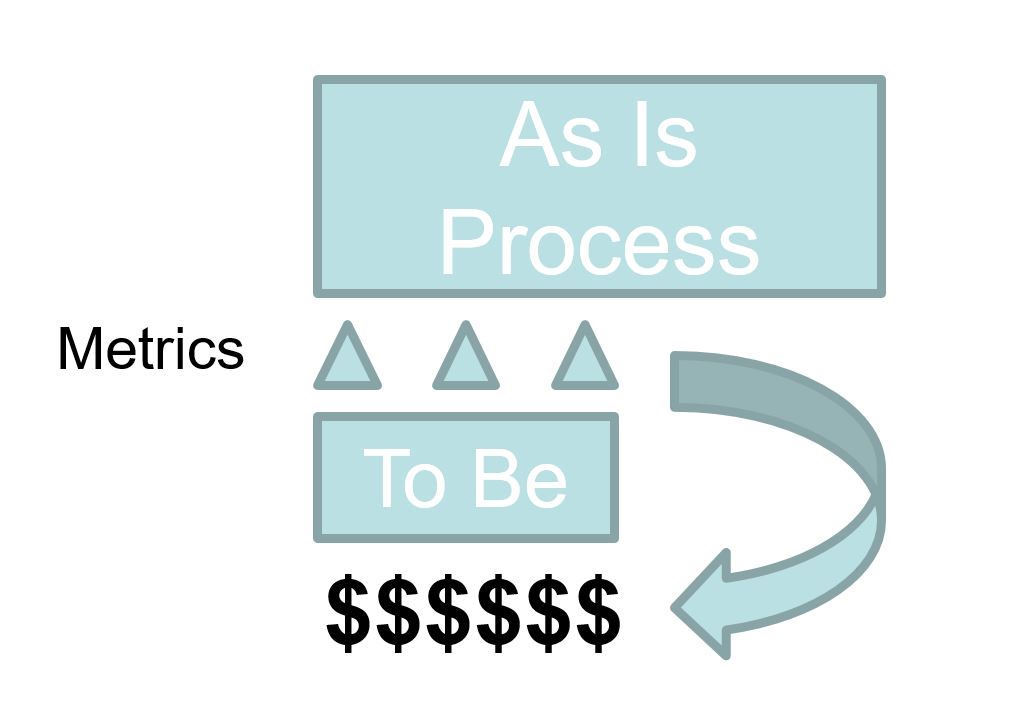
If you think about your processes at home or your business processes at work, you travel through this same re-engineering process. First you look at the "as is" process and identify what does not work. You find a motivator for the effort required. Then you re-engineer and remove the non-value added steps creating the "to be" process. Next you put in place reinforcing systems like metrics and that drives the change in behavior to get the value from the new process.

That is Business Process Re-engineering simplified!

Monday, August 3, 2015

10 Quotes That Could Mean Your Maintenance Program is Not Quite Best Practice

The following are ten quotes I have heard over the years that might not speak well of your maintenance and reliability efforts or the culture that has been created. The question is have you heard any of these in your facility? What did you do?

"I don't need a vibration analyzer, I use a screw driver and my ear."
"Prebreak is a thing. You can not go to break with dirty hands"
"The way we do it now is obviously the best way... Obviously, or we would not do it that way."
"A hammer is a precision maintenance tool and a knife is an acceptable screwdriver"
"Grease is grease and oil is oil"
"Is this an interruption? My break clock restarts with any interruptions"
"My maintenance jobs expand and contract to fit the job estimates. Tell me how long you want it to take"
"Our maintenance guys come in pairs and sometimes coveys regardless of the size and scope of the job"
"Our maintenance guys know the best gossip because we send them back and forth over and over for parts and tools and they see and talk with everyone."
"Yea we have predictive maintenance tools they are on the shelf in the office" under a coating of dust.

Please share you favorites below in the comments... Do not be shy we know the quote came from another plant not the one you work in now.

If you want to change the culture of your facility check out these post by clicking here!


Tuesday, July 20, 2010

Metric Waste

“Metric Waste”
Do you have a ton of metric waste; an overabundance of key performance indicator (KPI)?
Many facilities today have become metrics collectors, never throwing away metric and generating reports with lots of data but no real useful information. It gets to a point in many facilities that they have full time equivalent (FTE) head count just collecting metrics data and generating reports. These metrics and reports may never be viewed or used to make business decisions or check on organizational progress.  Does this sound familiar? Let us look at a few points to consider when building a metric strategy.
Most levels of the organization can manage no more than ten metrics at one time. So, if you look at an organizational chart and assign your metrics, can you limit them to ten at each level? Some metrics will exist at multiple levels and you must keep that in mind as you complete this exercise. The best way to look at your metrics is to start at the top with the metrics that address the facility’s vision and purpose. Then your can tier or cascaded down from that goal forming a tree of metrics that measure what is important to each level. When you complete the cascading metrics you should find that each levels metrics are supported by the level below.
Secondly, a portion of the metrics should be driven by the current improvement strategies. For example, if you are trying to improve work order history, one of your maintenance level metrics could be percentage of work orders containing follow up comments or notes. This will drive organizational focus on that portion of the improvement strategy until it becomes the new norm.
The third point to remember is that metrics are not “holy metrics”. We don’t have to keep them forever. We put them in place to insure change or prevent change. When insuring change you may find that you gather and measure more often however when preventing change you can measure at a lesser frequency because they should not change as quickly. The key here is to look at the trends. If the metric value very seldom changes much this could mean that the change that the metric is driving is now ingrained in the culture and is the new way of doing business. This is the point where you can eliminate the metric or extend its frequency of observation to the metrics standard you use for preventing change. Once we eliminate a metric we can then add a new one to our dashboard that addresses a change that we are trying to make or a process we are trying to understand.
The forth point to consider is leading versus lagging indicator. If you are managing based off of only lagging metrics it is attune to diving a boat while only looking at your wake. If you practice this philosophy you could find yourself happily driving into an oncoming freighter sized problem with no real warning.
If you are going to bench mark your metrics with other facilities then the definitions and data sources become very important but if you are using them internally only then you can concentrate on the delta and look for improvement or change. If you are looking for standardization one great source is the Society for Maintenance and Reliability Professionals (SMRP). They have a great new metrics compendium that provides all the details you need on sixty plus common use metrics.
In the end, metrics are just tools and should be used when you need them. They should provide a look at the future and not just the past and there should not be thousands of them in play all at once. If you design your metrics strategy with a bit of thought you can eliminate the wasted time and resources and have a much more effective program that drives business results.