Pages

Showing posts with label BPR. Show all posts

Monday, November 5, 2012

Force versus Finesse

Forcing Misalignment
This weekend I was watching my daughter assemble a toy robot. She is young and does not yet understand the concept of finesse. She is more of the brute force school of assembly. In her mind, if it doesn't go together then what you need to do is push harder. If you need to escalate beyond that then bang it on something. If that doesn't work then it is obviously broken and therefor can't be assembled. You can see her in the photo misaligned and still pushing harder.
Alignment Finesse
As I watched this I realized she is not the only one who does this on a regular basis. Many times we get a process or method in our mind and we skip the finesse and go strait for brute force. In our world it may look a bit different but it could sounds like this: "Boss says I have got to get this new process rolled out... I told our folks to just follow the new process... They didn't follow the process so I am going yell and scream about following the process... If that doesn't work then I will let them know that they are just not going to work out and I will look for someone who will follow the process." OK maybe a bit simplified and exaggerated but my money is on it not being that far off.
The real problem may be that the method being installed or implemented does not fit the application or the process is too different culturally for folks to grasp. Digging deeper we find that we did not take the time to look at the situation and understand all of the moving parts and how they work together. It could be that we missed an emotional, political, or rational issue with the change and until we look at each of these areas and address any underlying cause then adoption may escape us.
If you are in that situation take a look at the three areas shown to the above left. Think about what could go wrong in each of the dimensions and how you can proactively address that area using finesse in the place of sheer force.

Tuesday, January 10, 2012

What I learned from a paper mill in Canada

What I learned series post 1

This is series of post will cover basic concepts and "ah ha" moments that I have had over the years in the various companies that I have consulted. Some of the content will be common places in your facility and some of it may be new but I share it all with the intent to provoke thought and demonstrate how many things are the same no matter what the end product of the facility.  If you would like to know more about any of the topics please feel free to contact me.
Paper Mill
  1. Unions can drive change initiatives as much or more than leadership. They can be an excuse for why change is stalled, or they can be the reason for success with a change initiative. It is up to the leadership and the relationship they foster. This facility had five unions and four supported the change and the fifth did not fight it. The key to this support was open transparent communication, involvement, and a clear understanding of what was at stake for all parties in the end.
  2. Communication planning is crucial but execution is everything.This is one of the best examples of the change initiative being planned and the details socialized that I have ever seen. The project leaders brought everyone in the plant together to hear the message and learn of both the concepts being implemented and the tools that would be used to ensure success. They also spoke of the risk and what they had planned to mitigate them. It was a great process to be a part of.
  3. Burning platforms burn. Focus on these driver for change and use them to make progress but remember they are nearly single use so the same motivator can not be the burning platform that you continuously use for every change initiative.  This was a facility that knew their fate if an improvement was not made. They could see that they had to make a change or their high production cost would price them out of the market. They used it effectively and were successful in creating a fundamental change in performance.
  4. It is hard to see the changes you are making when you are in the middle of them. Especially in the planning phase. As you start to move through the change journey you will not always be able to see the progress that you are making in terms of bottom line performance gain. Use a master plan to show the items that have been successfully completed and celebrate the little steps until the journey you have made becomes apparent.  
There were many other learnings from this site and it was one of my favorite sites because of their desire to change and the hard work they put into making it happen. 

Monday, September 26, 2011

Are You Paving Cow Paths With Your EAM Implementation?

If you have ever spent any time walking around a cow pasture you may be familiar with three things about it that remind me of the Enterprise Asset Management (EAM) systems implementations. First, the paths the cows choose to follow are convoluted and entrenched in the history of the herd much like many EAM and the business processes they support. Secondly, there are many traps to step in along the way to a full implementation. Lastly two out of three cow pastures stink, a statistic that holds true for EAM implementations as well.
Lets explore this cow path analogy a bit more. Your organization, over time, using the past EAM or Computerized Maintenance Management System (CMMS) has created both formal and informal processes for getting a work order or work request from one place to another. These paths have dead ends and lots of wasted steps from one part of the process to another. They are not necessarily logical but they have historically gotten the results we have become accustom to. To say it simply they got us from the field to the barn and back again. The focus was on getting it done not getting it done at the level of efficiency that is required to be competitive today.
The problems comes in when many people began to implement  their new EAM system and they choose just to automate the old processes without first taking a hard look at the effectiveness of those processes. This is equivalent to paving the old cow paths. They are faster to travel on but at the end of the day they are so crooked and illogical that you do not get the step change in performance you or your boss expected from the investment.
Two keys to avoiding this loss in potential performance is completing true current and target (also known as "as is and to be") process mapping where you leverage what you already do right while eliminating the dead ends, traps, and non value added activities. Leveraging what you do right will help tremendously with your change effort and your sustainability. The second thing that will help is not relying just on your EAM vendor or internal IT department for help with the best practices process part. If you do then you can expect the best practices in software use and not best practices in maintenance and reliability. Reach out to others who are doing it right in your industry and outside of it, use the many books that exist on the topic or bring in any one of the many consulting organizations that focus in this area. If you take this step you can ensure that the new processes that you put in place not only work with the software but also drive the reliability of your facility to its full potential at the lowest overall cost.
In the end, do not miss a huge opportunity to make a step change in reliability performance just because you chose or are lead down the less painful and newly paved cow paths.

Monday, September 12, 2011

The Basics of Reliability Series: Project and Change Management


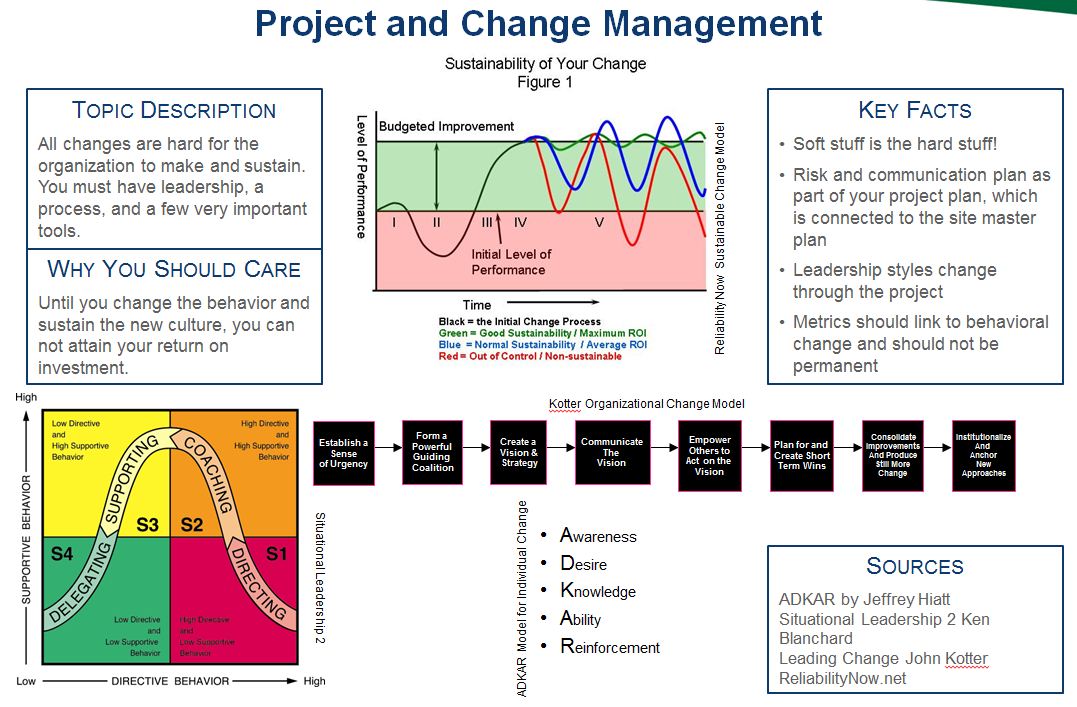
The last single point lesson in this series covers project and change management. Three models are used to make sure everyone understands that improving reliability is a “big deal” change and that it has to be treated as such. With that said they must think about individual, organizational, and leadership change in order to be have the best chance of success.
The first two models can almost be treated as checklists at their simplest level (if you dive deeper they yield much more insight). They include Kotter’s model for organizational change management and the ADKAR model for individual change from Prosci and Jeffery Hyatt. These models help us see when we need to do certain steps, why we need to do them, and what can happen if we miss or skip a step. Both models are very linear processes, which works great for those of us (engineers) who are drawn to the sequential things in life. If you follow them in order they will increase your likelihood of success by moving the effected individuals and the organization as a whole forward through the valleys of change where they become easily overwhelmed and on to the new level of performance.
The last model is the change curve, which is based off of Blanchard’s model for Situational Leadership 2. It shows that the needs of the effected parties will change as they mature through the change process. This means that as leaders, we must change as well. In the four-box graphic, you can see what these individuals will need as they progress, and the numbers in each box correspond to the areas shown with roman numerals in the Sustainability of Your Change model.
Ultimately, the real take away is not these five single point lessons; it is the understanding for why they exist. We need to communicate the reliability message multiple times from different people in different ways, and in the end, the listeners should all come to the same conclusions, which allows us to get the required results. Use these single point lessons or create your own and communicate, educate, and assimilate your way to excellence in reliability.

Monday, August 15, 2011

The Basics of Reliability Series: Work Execution


This post is the first in a five part series that will include single point lessons that can be used to further communicate each of the topics to your organization. 

Work execution management is the full process that has to occur from the time a problem is first discovered until it is planned, scheduled, and repaired, failure history is collected, and the work order is closed or completed. This process is the backbone of reliability improvement; without it, it is very hard to see results in most of the other areas. For example, if you implement predictive tools without a good work process, all you get is a lot of identified work with no way of having it completed efficiently and effectively.

 Work Execution Management Single Point Lesson Figure 1

We will use the WE single point lesson (see figure 1), which includes the funnel model for planning and scheduling and the as is and to be reengineered model, to help individuals understand the following key points.
Forecasting work is not easy, but it is a required part of a successful work process.
Work approval processes are important for control of maintenance spending and to ensure best resource utilization.
Ready and Total Backlog concepts help maintenance managers to control staffing decisions with science instead of emotion. Planners and managers must be communicating constantly in order to properly provide for the Ready Backlog.
The funnel model also shows us where in the process we will develop effective work procedures and how we ensure that particular process has the correct inputs.
The WE single point lesson illustrates what the schedule output looks like and what inputs must be provided, including details from both operations and maintenance inputs of resources, downtime, and priority.
Last but not least, it drives the need for the process to ensure nothing is left out or missed. This process reengineering is shown as a big wasteful “as is” block that is refined into the more concise and direct “to be” block. Metrics are used to drive this change and ensure the return on investment.
We get all of this from two simple graphics that you can draw and share in a matter of minutes. 

Friday, July 8, 2011

Best Practice is not Good Enough: Are You Moving Toward "Future Perfect"


I was listening to an individual talking about business and improvement this week and he said a few things that resonated with me. I thought I would share them today in the context of reliability improvement.
Improvement initiative should move all elements toward the perfect state not just better than the competition or better than your sister plant or even best practice. He acknowledged that it may be unattainable financially or otherwise but it should still be the point you strive for. Many organizations map their currents state process and then make only the smallest of tweaks to these processes calling them the future state (because they believe they are already pretty good ). In the ultra competitive business environment what they really needed was a step change in performance to remain in or regain the highly profitable top spot.  If the same organization were to compare against the perfect state they would realize more of the possibilities available to them leading to better overall results.
So that got me to thinking what are some of the “future perfect” states of reliability and what could we learn from them…
Zero Unplanned Downtime\Zero Breakdowns
All work is planned and schedule.
Through the use of Root Cause Analysis (RCA) and Reliability Centered Maintenance RCM) the site could move closer to this state of zero unplanned downtime by eliminating the reoccurring failures with a failure mode based maintenance strategy.
Zero Parts Inventory
In a fully planned and scheduled world parts can arrive in a just in time (JIT) manor. In this perfect state, parts arrive to the job site just minutes before they are needed. Now we have eliminated the caring cost of all the spare parts that would normally reside only on the books and in the store room.
A perfect balance of labor and required work backlog
Many facilities shoot for 10-12 percent maintenance overtime to ensure that they have enough people to get the volume of the work done without having too many idle hands when the backlog is light. What if we could eliminate the need for overtime because our plans were so accurate and our schedules were so exact that we were left with a balanced equation every time.
What others can you think of? Even though you can’t necessarily attain them all how does the “future perfect” change your perspective of what is possible?
Thanks Rich MacInnes for spurring the thoughts!

Monday, May 16, 2011

“But We Are Different”

These are four words that I hear at the beginning of every reliability improvement journey but I’m sure you could hear it at the beginning of any major change where comparisons are made to “best practices”.
Let me first explain why it is so common. It is all driven by the way people accept change also known as change dynamics. The Kubler-Ross model for grief gives us a great place to start understanding this common phrase. This grief model was the genesis of many of the organizational change models that exist today including the one that was shown in my July 9th blog on change dynamics. In Kubler-Ross the first stage is denial and the individual is denying that they can make the change. They are denying it could work for them. The list of reasons are long but for fun I have included a few that I have heard at the beginning of what became some very successful change project:
We are different because…
                                          we are smaller
                                          we are bigger
                                          we make smelter power (still not sure how this one is different)
                                          we are older than the others
                                          we are a new facility
                                          we are on an island
                                          we are in the city
We as change leaders, have to help the group discover that they are capable of operating differently and that it is normal to think that they are different and that the improvements or tools will not work for them. This is a great time to show them examples of others who have made the journey and just how different they weren’t.
From a reliability improvement project standpoint we show them the deliverables, tools and process and then we describe how they were used in two completely different locations. We convince them of the existence of our version of the “The Grand Unification Theory” which states that standard improvement tools are universal and they work no matter what you do or where you do it. For instance process mapping works in hospitals and aluminum smelters. It works on all business processes. Root Cause helps the Navy solve problems just as well as the pharmaceutical industry. Failure modes analysis works on equipment and it can also be used on change projects as a risk identification and mitigation tool.  In the end these and other basic tools work to shape a solution that is tailored for their culture and can help them make the transition to "best practices" levels of performance.
So when you hear the words “but we are different” you know that this is your opportunity to educate on the dynamics of change, what they can expect during each stage, and the “The Grand Unification Theory”
Be different and make a change

Friday, May 6, 2011

Don’t Stop at RACI

I was recently in attendance for a “best practice” presentation where the presenter said “the value of RACI is in the exercise… we never looked at ours again”, and there I found my soap box.
Before I climb up on said soap box, let me first explain the acronym RACI, or RASI as some call it. RACI stands for Responsible, Accountable, Consulted, and Informed. In the case of RASI, the last two letters change to Support and Information. There are other variations out there as well. I have added one simple example below.
RACI is a tool we use during business process reengineering that clarifies roles for each step within the business process. So, to put this in the simple contexts of how it is used, we would first start by mapping out the “as is” or current state process. Then we would identify both valuable steps and waste. The waste would be engineered out and the valuable steps would be carried forth to the “to be” or target process. At this point, we would list who, by title, is responsible or accountable for each step in the process. This is where the presenter stopped…
Here are a few of the problems associated with stopping at this point:
RACI are done in small focus teams; therefore, only a small part of the population that will be affected by the change is present.
Second, what if the HR-stored job descriptions do not contain these steps or, worse yet, contradict them.
Third, if we believe “what we measure gets improved”, then the changes in responsibility have to be associated with metrics to ensure the change.
In order to build this into the culture, you must take this a step further. You should take all the new RACI tables for your business process and reorganize them by job title. You then take this list of tasks by job title and compare it against your existing job descriptions. Are they the same? Can one person do all of the activities from the RACI and the job descriptions? In many cases, the job descriptions are old and out dated and when they are compared to the RACI task list, it is more than one person can handle. At this point, you begin to combine the two and redistribute the work. Remember, if you change anything from the RACI list, you have to go back and revisit the processes and original RACI documents. Once you have finalized the new RACI job descriptions, then you create performance metrics to drive the changes and use the new document in all performance reviews. If you take this extra step, then your performance management system and metrics will be linked to your business processes, which in turn will drive the new behavior that the business process reengineering effort requires for success.