Over more than ten years of consulting and training globally, I have watched a lot of companies spend an incredible amount of money to go after an organizational change in a very unsustainable way. Today's post will list three of the most frustrating and ineffective ways to make unsustainable change. Don't set out with failure as a goal or a likely destination.
Problem #1: Asking consultants to do it all for them. "But it easy to let the "experts" do it"
There are many consultants who will be more than willing to come in and do all of the heavy lifting. Consultants want as many billable hours as possible and taking it all on provides for their goal. Many of them do not drive sustainability, in fact, if it doesn't get sustained then they can come back again in a few years and sell more billable hours to right the ship. Now don't get me wrong, there may be times where you require a hired gun to knock out some elements because of resource constraints, however this should be used with caution and not applied to processes that require much organizational buy-in and change. We know organizational change is hard but it is no different than going to the gym... you can't let someone else lift the weight for you.
Problem #2: Not developing the solution from within. "Why would I develop it when I can just copy someone else?"
There is study after study that shows that the solution is most effective when it is developed from within. Without this ownership of the solution the organization struggles to implement and sustain. Are you suffering from the same issues the site that created the solution was? For example, a long distance runner does not use the same workout plan as a power lifter. Do you have the same culture? Are you at the same maturity, with the same performance gaps? You would not wear a tutu to a tractor pull just because somebody said you needed some clothes. So, don't put on someone else's solution just because it covers some of your important parts. In the end, a solution may share features or best practices but should be developed as part of a journey of self-discovery.
Problem #3: Not learning how to do it themselves. "Just give me the overview, I've got people for that"
If someone else develops it, and someone else implements it, then you don't get the education that is required to sustain it. The overview taught as the implementers are on the way out the door will be completely ineffective. During studies of how adults learn, it has been proven that retention of the material increases substantially when the content is directly applicable to the task at hand. If all of the heavy lifting has been done, then you as a learner have little reason to retain the content that is being delivered to you. Especially, if it is in the form of a 372 power point slide presentation that the guy in the front of the room is reading so he can go on to his next big gig. The best way is to ensure your organization is capable of sustaining the change is through a process where you learn best practices, apply those practices in your facility within the boundaries of processes you develop with the help of others in the organization. It is a bonus, if you can take that journey with a trusted adviser or coach that challenges the decisions you make but does not do it for you. Think of this as a personal trainer. They guide you down a path to success but they do not try to lift the weight for you.
In the end, we want to lift the weight for ourselves (organizational implementation), develop a work out plan that is based on our gaps and goals (facilitated self-discovery of the path and processes) , and work with a trainer to learn what to do and when to do it to get maximum results (learn by doing with coaching). If you implement with these three potential goals, then you will be one step closer to creating a sustainable habit and dodging an incredible improvement fail.
Showing posts with label Business Process Re-Engineering. Show all posts
Friday, October 2, 2015
Tuesday, August 11, 2015
Simple Demonstration of How Business Process Re-Engineering Really Works
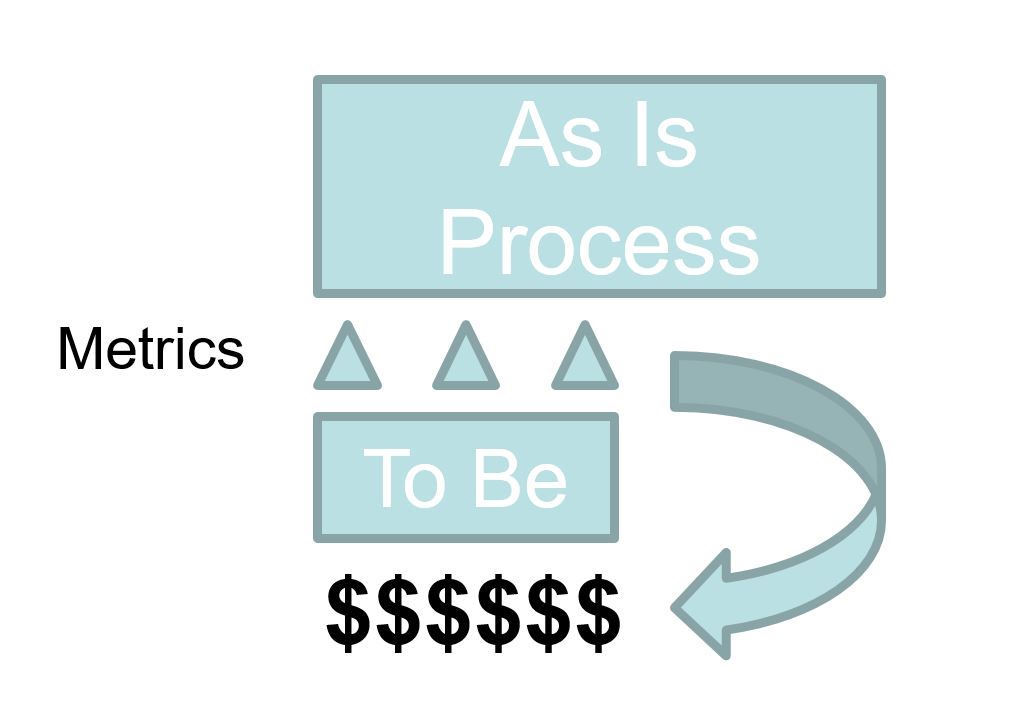
So I noticed recently that my personal morning routine had some waste in the process. If I could remove this waste I could sleep longer and still make it to work on time. That was enough motivation to get me started. I was going to re-engineer my morning process. I studied the current or "as is" process and found that the time waste was only just over a minute. But, when you think about the fact that this waste was part of a daily routine the minutes added up to 6 hours of waste in my life every year. I saw this as 6 more hours of sleep annually. I found that to be an amazing discovery so I set off to remove the issues from the process. As part of my current process I shaved prior to brushing my teeth. The problem with this was that I had to wait for the water to warm up before shaving. Cold water causes an off quality shave and is a safety issue with a blade. This delay also included a waste of natural resources namely off temperature water. By remapping my morning process to include brushing my teeth while the water warmed up and before I shaved, I made use of the off quality (cold) water and did not have the associated idle time. While I brushed my teeth the water would warm for the shave. I tested and verified that the new process was effective and made it my target or "to be" process. Now I only had to ingrain the change into my lifestyle. Change management and visual reminders were important because at 6 AM I am not always at the top of my game. I found myself falling back into the old way without the reinforcing elements. Over time it became the way of doing my morning and the reinforcing systems were no longer as important and could be relaxed or removed. The changed state was now the new current state.
If you think about your processes at home or your business processes at work, you travel through this same re-engineering process. First you look at the "as is" process and identify what does not work. You find a motivator for the effort required. Then you re-engineer and remove the non-value added steps creating the "to be" process. Next you put in place reinforcing systems like metrics and that drives the change in behavior to get the value from the new process.
That is Business Process Re-engineering simplified!
If you think about your processes at home or your business processes at work, you travel through this same re-engineering process. First you look at the "as is" process and identify what does not work. You find a motivator for the effort required. Then you re-engineer and remove the non-value added steps creating the "to be" process. Next you put in place reinforcing systems like metrics and that drives the change in behavior to get the value from the new process.
That is Business Process Re-engineering simplified!
Tuesday, October 29, 2013
Are Your Business Processes Traffic Bottlenecks?
First up sorry about the blog unreliability recently. We are back after a short break and focused on helping you with your pursuit of reliability.
So this week I was caught in traffic and that got me thinking about processes. Processes are like the roads we follow. In the picture you see many people following the process. Unfortunately it has a bottleneck ahead. Now what if I decided to leave the road and drive into the grass? I could move much faster there outside of the normal process right? The problem occurs when everyone decides to leave the process. Now, we are all out in the grass going different ways and causing damage and congestion.
This is what happens in many facilities. They build great processes through their lean implementation or EAM or ERP roll out but over time things change and it becomes easier to work off process through a work around than it is to follow the outdated process with all of their bottlenecks. This is not catastrophic at first because only a few power users are running off in the grass but over time more and more people tire of the bottlenecks and create their own path. Then data and people start colliding and the system starts to struggle because it is not being used the way it was designed. After a period of time you are left with carnage and debris and truly broken processes. Inefficiency takes over and waste piles up everywhere.
So how do we avoid it? I like to do a yearly process review and improvement event. It starts by printing out all of your processes on large format paper and posting them on the wall. I then get multidisciplinary groups of users to come in and we go through the processes box by box or step by step. We are looking for changes that have occurred or should occur, "work arounds" that have been instituted and broken connections from one process to another. I reward honesty during this process and we note what we like and what is not getting us where we want to be. We study the "work arounds" and see if they should become the revisions to the process. An added benefit of the exercise is that we are reviewing and reminding the groups of what we have said we will do and they are adding details that increase their ownership of the processes. After this exercise, compliance goes up and efficiency follows as well.
Are you doing yearly process improvement events as part of your continuous improvement plan?
So this week I was caught in traffic and that got me thinking about processes. Processes are like the roads we follow. In the picture you see many people following the process. Unfortunately it has a bottleneck ahead. Now what if I decided to leave the road and drive into the grass? I could move much faster there outside of the normal process right? The problem occurs when everyone decides to leave the process. Now, we are all out in the grass going different ways and causing damage and congestion.
This is what happens in many facilities. They build great processes through their lean implementation or EAM or ERP roll out but over time things change and it becomes easier to work off process through a work around than it is to follow the outdated process with all of their bottlenecks. This is not catastrophic at first because only a few power users are running off in the grass but over time more and more people tire of the bottlenecks and create their own path. Then data and people start colliding and the system starts to struggle because it is not being used the way it was designed. After a period of time you are left with carnage and debris and truly broken processes. Inefficiency takes over and waste piles up everywhere.
So how do we avoid it? I like to do a yearly process review and improvement event. It starts by printing out all of your processes on large format paper and posting them on the wall. I then get multidisciplinary groups of users to come in and we go through the processes box by box or step by step. We are looking for changes that have occurred or should occur, "work arounds" that have been instituted and broken connections from one process to another. I reward honesty during this process and we note what we like and what is not getting us where we want to be. We study the "work arounds" and see if they should become the revisions to the process. An added benefit of the exercise is that we are reviewing and reminding the groups of what we have said we will do and they are adding details that increase their ownership of the processes. After this exercise, compliance goes up and efficiency follows as well.
Are you doing yearly process improvement events as part of your continuous improvement plan?
Monday, November 5, 2012
Force versus Finesse
![]() |
| Forcing Misalignment |
![]() |
| Alignment Finesse |
The real problem may be that the method being installed or implemented does not fit the application or the process is too different culturally for folks to grasp. Digging deeper we find that we did not take the time to look at the situation and understand all of the moving parts and how they work together. It could be that we missed an emotional, political, or rational issue with the change and until we look at each of these areas and address any underlying cause then adoption may escape us.
If you are in that situation take a look at the three areas shown to the above left. Think about what could go wrong in each of the dimensions and how you can proactively address that area using finesse in the place of sheer force.
Monday, April 23, 2012
FMEA: Its Not Just for Maintenance Anymore
I find it very interesting how many of the tools we reliability and maintenance engineers use within our jobs apply in a much broader sense. The obvious one is root cause analysis or RCA as it is known. It could be applied by anyone to solve nearly any problem. In fact in my workshops I have had operations, human resources, and even information technology folks learning about the processes and tools to reduce or eliminate failures. But, have you ever thought of how you can use the failure modes effects analysis (FMEA) and its derivative failure modes effects and criticality analysis (FMECA) process beyond just equipment maintenance plan development?
I find it can be used for every project that you are a part of. For example say you have been asked to be part of a team that is implementing SAP or Maximo or any other EAM. One of the first things you need to identify after scoping and charter is a risk plan and in essence that is exactly what an FMEA creates. You can look at the goals of the project then consider what might go wrong to diminish goal attainment. Then you can use risk priority number (RPN) from a FMECA to sort the potential issues. Lastly, the team can design mitigation or elimination steps for those failure modes that meet a minimum risk threshold. So for example, if one of the goals, or functions in FMEA speak, of the project is to complete the implementation in nine months you might consider that a site leadership change could affect the group’s ability to meet this goal. The change in leadership could mean a change in priorities etc. We would then look at its RPN by asking: What is the likelihood of the leadership changing? How bad would the leadership change effect on time project completion? And what are the chances we could detect the leadership change prior to occurrence? This would lead us to a ranked list of potential failure points or modes. We could then build elements into our communication plan and other project plans to proactively address these potential failure modes. Then, if they do occur everyone would be aware and prepared to address them.
What other RE and ME tools do you use in unorthodox ways?
Tuesday, January 10, 2012
What I learned from a paper mill in Canada
What I learned series post 1
This is series of post will cover basic concepts and "ah ha" moments that I have had over the years in the various companies that I have consulted. Some of the content will be common places in your facility and some of it may be new but I share it all with the intent to provoke thought and demonstrate how many things are the same no matter what the end product of the facility. If you would like to know more about any of the topics please feel free to contact me.
![]() |
| Paper Mill |
- Unions can drive change initiatives as much or more than leadership. They can be an excuse for why change is stalled, or they can be the reason for success with a change initiative. It is up to the leadership and the relationship they foster. This facility had five unions and four supported the change and the fifth did not fight it. The key to this support was open transparent communication, involvement, and a clear understanding of what was at stake for all parties in the end.
- Communication planning is crucial but execution is everything.This is one of the best examples of the change initiative being planned and the details socialized that I have ever seen. The project leaders brought everyone in the plant together to hear the message and learn of both the concepts being implemented and the tools that would be used to ensure success. They also spoke of the risk and what they had planned to mitigate them. It was a great process to be a part of.
- Burning platforms burn. Focus on these driver for change and use them to make progress but remember they are nearly single use so the same motivator can not be the burning platform that you continuously use for every change initiative. This was a facility that knew their fate if an improvement was not made. They could see that they had to make a change or their high production cost would price them out of the market. They used it effectively and were successful in creating a fundamental change in performance.
- It is hard to see the changes you are making when you are in the middle of them. Especially in the planning phase. As you start to move through the change journey you will not always be able to see the progress that you are making in terms of bottom line performance gain. Use a master plan to show the items that have been successfully completed and celebrate the little steps until the journey you have made becomes apparent.
Tuesday, December 27, 2011
Top 5 Maintenance and Reliability Acronyms for 2011
As the year comes to a close you begin to see a lot of list. These list cover the top X "somethings" of 2011. They are beginning to show up on the TV, the radio, and the web. In fact, on the way in to the office I heard part of the top 40 pop songs of 2011. With all of these list flying around I could not help but think about the top topics for maintenance and reliability in 2011. I have looked back over conference proceedings, discussion group post, website and blog traffic and have put together a top five acronyms list with a bit of commentary on each.
5. PdM
Predictive Maintenance is one of the maintenance and reliability tools that sites are using more and more in the place of their time based preventive task. This year, as the cost of the technology continue decreasing, more folks are adopting the technologies and wanting to talk about them. I think the key point with PdM is that your work execution process has to be strong or these technologies will just identify a lot more work that you can not get through your planning and scheduling system to execution before it runs to failure.
4. CMMS/EAM
Computerized Maintenance Management Systems/ Enterprise Asset Management Systems continue to be a big discussion point for many folks as they struggle to get the value and return on investment from these systems. Many folks continue to see the CMMS as the solution instead of the tool that enables good processes to be successful.
3. RCA
Root Cause Analysis has been very popular on this blog this year but I must admit it could be because of my focus on it as a great tool to eliminate reoccurring failures and process losses. I think the one point I would share is this: RCA doesn't have to be complicated but it requires a great deal of follow to get good results.
2. BPR
Business Process Re-engineering is a topic we see and hear most discussed around EAM implementations and LEAN projects. This tool and the process that are associated with it can remove a substantial amount of waste from your work flow. The key element for success is not that different from RCA it requires tremendous follow up and a regiment that includes the change management methodologies and our number one topic for 2011... KPIs.
1. KPI
Key Performance Indicators or metrics as they are sometimes called have been an intense area of focus this year. They generate lots of interest as sites try to figure out where they are and how they compare to others. The one suggestion I would provide for this topic is the following: Don't compare what you dont understand. Take the time to note how the metrics are calculated and how your methodology differs from others you may be comparing with. Too often I see dissimilar metrics compared and poor discisions made based on the conclusions. If you can standardise on metrics using documents like the SMRP Metrics Compendium that is avalible through SMRP.org then you can remove some of the frustration around metrics and KPIs.
I would also be remiss if I did not mention one topic that does not have an acronym yet but was a major topic of interest in 2011. That topic was the skills crisis or the departure of the baby boomer generation from the work force. Many of the acronyms above are crutial to capturing this departing knowledge and allowing for its use in the future. The key is to start now.
Reliability Now!
Thank you to all of you who have followed this blog this year and I wish you a Happy New Year
5. PdM
Predictive Maintenance is one of the maintenance and reliability tools that sites are using more and more in the place of their time based preventive task. This year, as the cost of the technology continue decreasing, more folks are adopting the technologies and wanting to talk about them. I think the key point with PdM is that your work execution process has to be strong or these technologies will just identify a lot more work that you can not get through your planning and scheduling system to execution before it runs to failure.
4. CMMS/EAM
Computerized Maintenance Management Systems/ Enterprise Asset Management Systems continue to be a big discussion point for many folks as they struggle to get the value and return on investment from these systems. Many folks continue to see the CMMS as the solution instead of the tool that enables good processes to be successful.
3. RCA
Root Cause Analysis has been very popular on this blog this year but I must admit it could be because of my focus on it as a great tool to eliminate reoccurring failures and process losses. I think the one point I would share is this: RCA doesn't have to be complicated but it requires a great deal of follow to get good results.
2. BPR
Business Process Re-engineering is a topic we see and hear most discussed around EAM implementations and LEAN projects. This tool and the process that are associated with it can remove a substantial amount of waste from your work flow. The key element for success is not that different from RCA it requires tremendous follow up and a regiment that includes the change management methodologies and our number one topic for 2011... KPIs.
1. KPI
Key Performance Indicators or metrics as they are sometimes called have been an intense area of focus this year. They generate lots of interest as sites try to figure out where they are and how they compare to others. The one suggestion I would provide for this topic is the following: Don't compare what you dont understand. Take the time to note how the metrics are calculated and how your methodology differs from others you may be comparing with. Too often I see dissimilar metrics compared and poor discisions made based on the conclusions. If you can standardise on metrics using documents like the SMRP Metrics Compendium that is avalible through SMRP.org then you can remove some of the frustration around metrics and KPIs.
I would also be remiss if I did not mention one topic that does not have an acronym yet but was a major topic of interest in 2011. That topic was the skills crisis or the departure of the baby boomer generation from the work force. Many of the acronyms above are crutial to capturing this departing knowledge and allowing for its use in the future. The key is to start now.
Reliability Now!
Thank you to all of you who have followed this blog this year and I wish you a Happy New Year
Wednesday, December 14, 2011
Don’t Start Up In a Bad Way: Five Ways to Limit the Creation of a Reactive Culture in New Facility Startup.
New facilities by nature can be reactive. Reactive behavior when it comes to reliability and maintenance is expensive. Our goal should be to be proactive in identifying risk and mitigating or eliminating it before we have to react. When you bring a new plant online there are many things that can drive the culture to be reactive. I have listed a few below:
- Poor start up planning and procedures
- The presence of excessive amounts of infant mortality type failure modes
- Equipment delivery delays
- Stocking of incorrect spare parts
- EPC contractor ineffectiveness
- EPC contract language that does not insure correct function of the assets
- No existing culture in the new facility while there is an influx of new employees from different cultures including other highly reactive companies.
With all of these reasons as well as others, it is no wonder that green field sites find themselves working to overcome a reactive culture, low production rates, and high cost. In order to limit the creation of this situation I have listed five way to turn the tide in favor of a proactive culture.
- Start early creating the business processes which will help to create the new culture. When you on board new associates being able to show them how work will be done and train them in the use of proactive tools is critical. This will allow them to change their existing paradigms where required and give you a head start on the culture that is required for maximum return on investment.
- Build the business processes based off of the best facilities in the world not just the best facilities in your division or company. Reach out with your early hire team and benchmark with an eye on being the best in the world within the constraints of your facilities business case.
- Create failure mode based maintenance strategies using the equipment vendors, EPC, associates as they are brought onboard, the operating context specific to your facility, and tools like RAM, RCM, and FMEA. If this step is done correctly then it will reduce spare parts stocking levels, equipment failures, and poor procedures which will increase early production and profitability.
- Budget for new associates to visit sister plants if they exist. The goal here is to ensure that they can have open dialogue with others who live with the assets on a daily basis. They should be looking to get hands on training, learn common problems, identify changes that have been made since start-up of the assets as well as other tidbits that will facilitate their site producing record tonnage the first year.
- Fully populate your EAM or CMMS from the start with all of the assets, spare parts, drawings, and failure codes as provided by the vendors per your contractual request.
I hope these five items offer some help on new plant or new asset start up and if you would like to learn more about the elements of a good start up then reach out to me via email and I will provide you with a look at our R5 launch methodology for new facilities.
Tuesday, November 22, 2011
Just Trust Me: "Reliability Rocks"
Just trust me "Reliability Rocks"... if only it were that easy. How do you describe it if you have never seen it and lived it? How do you sell it to your team?
The first two steps of the change process according to the Prosci organization and their ADKAR model is creating awareness and desire. It can be very hard to complete these steps if you have never seen or lived in the world you are aspiring to reach. It is a bit like asking someone who has never seen a pineapple to tell others how good the rough spiny fruit is to eat. It is nearly impossible to describe and if you can it is doubtful you will be able to convey it with the passion and energy that is require to kick start desire in others for the new thing.
When I describe a facility that I have spent considerable time in that has the ability to plan for the whole maintenance staff to leave at three on a Friday for a facility fishing tournament most just can not fathom this reality within their reactive world of firefighting. About the only thing these reactive sites can plan and predict is that important equipment will break down on Friday afternoons and Saturday nights. That is their paradigm. It is the reality of their world. This new world is so foreign and so different it is just not a place they can understand, yet.
The best way to create the desire is to show people what it is like to live in the new state. A part of your organization may be able to do this by visiting another site that has made it further along the road to reliability but it is doubtfully that you can take everyone. For the balance of your facility you should define an area that will embody as many as possible of the characteristics of reliability. This is your pilot area. You select this area with a mind for demonstrating gains and successes in a visual way so as to create desire from the rest of the facility. You need to pick a progressive area that has both early adopters that will help pull the change forward but also folks that will sustain the new process and ensure long term success.
This area is your pineapple. You can show it to the balance of the facility so that they can see what it looks like and allow them to visualize the fruits of the labor of change. The people that lead this pilot area to success can then become your gurus that propel the change forward in other parts of the facility and coach others to the success they have experienced based on what they have seen.
Monday, September 26, 2011
Are You Paving Cow Paths With Your EAM Implementation?
If you have ever spent any time walking around a cow pasture you may be familiar with three things about it that remind me of the Enterprise Asset Management (EAM) systems implementations. First, the paths the cows choose to follow are convoluted and entrenched in the history of the herd much like many EAM and the business processes they support. Secondly, there are many traps to step in along the way to a full implementation. Lastly two out of three cow pastures stink, a statistic that holds true for EAM implementations as well.
Lets explore this cow path analogy a bit more. Your organization, over time, using the past EAM or Computerized Maintenance Management System (CMMS) has created both formal and informal processes for getting a work order or work request from one place to another. These paths have dead ends and lots of wasted steps from one part of the process to another. They are not necessarily logical but they have historically gotten the results we have become accustom to. To say it simply they got us from the field to the barn and back again. The focus was on getting it done not getting it done at the level of efficiency that is required to be competitive today.
The problems comes in when many people began to implement their new EAM system and they choose just to automate the old processes without first taking a hard look at the effectiveness of those processes. This is equivalent to paving the old cow paths. They are faster to travel on but at the end of the day they are so crooked and illogical that you do not get the step change in performance you or your boss expected from the investment.
Two keys to avoiding this loss in potential performance is completing true current and target (also known as "as is and to be") process mapping where you leverage what you already do right while eliminating the dead ends, traps, and non value added activities. Leveraging what you do right will help tremendously with your change effort and your sustainability. The second thing that will help is not relying just on your EAM vendor or internal IT department for help with the best practices process part. If you do then you can expect the best practices in software use and not best practices in maintenance and reliability. Reach out to others who are doing it right in your industry and outside of it, use the many books that exist on the topic or bring in any one of the many consulting organizations that focus in this area. If you take this step you can ensure that the new processes that you put in place not only work with the software but also drive the reliability of your facility to its full potential at the lowest overall cost.
In the end, do not miss a huge opportunity to make a step change in reliability performance just because you chose or are lead down the less painful and newly paved cow paths.
Lets explore this cow path analogy a bit more. Your organization, over time, using the past EAM or Computerized Maintenance Management System (CMMS) has created both formal and informal processes for getting a work order or work request from one place to another. These paths have dead ends and lots of wasted steps from one part of the process to another. They are not necessarily logical but they have historically gotten the results we have become accustom to. To say it simply they got us from the field to the barn and back again. The focus was on getting it done not getting it done at the level of efficiency that is required to be competitive today.
The problems comes in when many people began to implement their new EAM system and they choose just to automate the old processes without first taking a hard look at the effectiveness of those processes. This is equivalent to paving the old cow paths. They are faster to travel on but at the end of the day they are so crooked and illogical that you do not get the step change in performance you or your boss expected from the investment.
Two keys to avoiding this loss in potential performance is completing true current and target (also known as "as is and to be") process mapping where you leverage what you already do right while eliminating the dead ends, traps, and non value added activities. Leveraging what you do right will help tremendously with your change effort and your sustainability. The second thing that will help is not relying just on your EAM vendor or internal IT department for help with the best practices process part. If you do then you can expect the best practices in software use and not best practices in maintenance and reliability. Reach out to others who are doing it right in your industry and outside of it, use the many books that exist on the topic or bring in any one of the many consulting organizations that focus in this area. If you take this step you can ensure that the new processes that you put in place not only work with the software but also drive the reliability of your facility to its full potential at the lowest overall cost.
In the end, do not miss a huge opportunity to make a step change in reliability performance just because you chose or are lead down the less painful and newly paved cow paths.
Monday, September 12, 2011
The Basics of Reliability Series: Project and Change Management
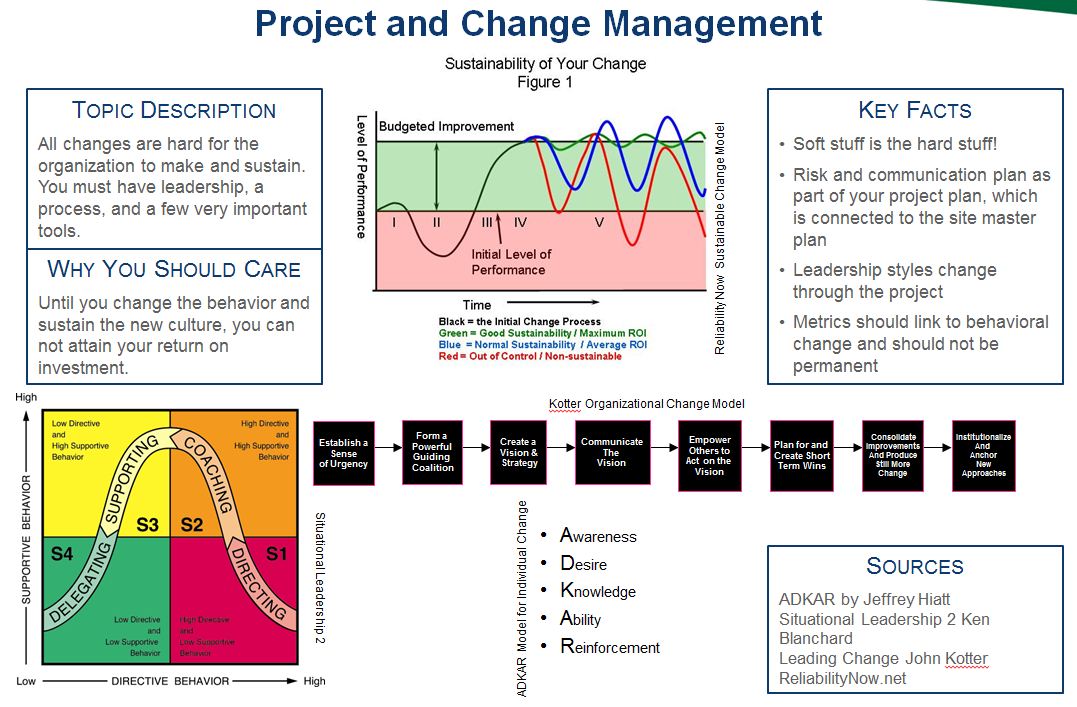
The last single point lesson in this series covers project and change management. Three models are used to make sure everyone understands that improving reliability is a “big deal” change and that it has to be treated as such. With that said they must think about individual, organizational, and leadership change in order to be have the best chance of success.
The first two models can almost be treated as checklists at their simplest level (if you dive deeper they yield much more insight). They include Kotter’s model for organizational change management and the ADKAR model for individual change from Prosci and Jeffery Hyatt. These models help us see when we need to do certain steps, why we need to do them, and what can happen if we miss or skip a step. Both models are very linear processes, which works great for those of us (engineers) who are drawn to the sequential things in life. If you follow them in order they will increase your likelihood of success by moving the effected individuals and the organization as a whole forward through the valleys of change where they become easily overwhelmed and on to the new level of performance.
The last model is the change curve, which is based off of Blanchard’s model for Situational Leadership 2. It shows that the needs of the effected parties will change as they mature through the change process. This means that as leaders, we must change as well. In the four-box graphic, you can see what these individuals will need as they progress, and the numbers in each box correspond to the areas shown with roman numerals in the Sustainability of Your Change model.
Ultimately, the real take away is not these five single point lessons; it is the understanding for why they exist. We need to communicate the reliability message multiple times from different people in different ways, and in the end, the listeners should all come to the same conclusions, which allows us to get the required results. Use these single point lessons or create your own and communicate, educate, and assimilate your way to excellence in reliability.
Monday, August 15, 2011
The Basics of Reliability Series: Work Execution
This post is the first in a five part series that will include single point lessons that can be used to further communicate each of the topics to your organization.
Work execution management is the full process that has to occur from the time a problem is first discovered until it is planned, scheduled, and repaired, failure history is collected, and the work order is closed or completed. This process is the backbone of reliability improvement; without it, it is very hard to see results in most of the other areas. For example, if you implement predictive tools without a good work process, all you get is a lot of identified work with no way of having it completed efficiently and effectively.
Work Execution Management Single Point Lesson Figure 1
We will use the WE single point lesson (see figure 1), which includes the funnel model for planning and scheduling and the as is and to be reengineered model, to help individuals understand the following key points.
Forecasting work is not easy, but it is a required part of a successful work process.
Work approval processes are important for control of maintenance spending and to ensure best resource utilization.
Ready and Total Backlog concepts help maintenance managers to control staffing decisions with science instead of emotion. Planners and managers must be communicating constantly in order to properly provide for the Ready Backlog.
The funnel model also shows us where in the process we will develop effective work procedures and how we ensure that particular process has the correct inputs.
The WE single point lesson illustrates what the schedule output looks like and what inputs must be provided, including details from both operations and maintenance inputs of resources, downtime, and priority.
Last but not least, it drives the need for the process to ensure nothing is left out or missed. This process reengineering is shown as a big wasteful “as is” block that is refined into the more concise and direct “to be” block. Metrics are used to drive this change and ensure the return on investment.
We get all of this from two simple graphics that you can draw and share in a matter of minutes.
Monday, July 18, 2011
Hot Rods and Hand Tools: Where have the skilled trades gone and how do we deal with their absence?
Below is a portion of an article that I will be presenting at the Houston Society for Maintenance and Reliability Professionals Annual Conference. I thought you might enjoy the high points. If you would like the longer more statistic laden version let me know.
Below are six elements that you can implement right now that will help to address the skilled trades shortage in your facility. These elements include the use of:
Due to the changing economy and American culture, we are seeing a long-term shortage of skilled trades. These skilled trades include the industrial Mechanics, Machinists, and Electricians who have kept American facilities producing the wealth to which we have become accustomed. This has been perpetuated by three compounding circumstances:
· The common Baby Boomer myth that everyone’s kids have to go to university to be successful and the overall negative cultural bias toward blue collar employment
· The movement from working on cars and hot rods in the garage with your father to playing video games or working on computers.
· And most recently, the inevitable Baby Boomer retirement, which has waned due to the economy, but is still a concern in the long run
· Clear documented business processes to ensure a smooth transition, continuous improvement, and employee involvement (which is key to the new generation)
· Training as both a knowledge and a morale booster (training assessment and implementation)
· Condition sensing technology (Predictive Maintenance (PdM) Tools) in the realm of maintenance and how they can bring the “cool” back to the skill trades
· Historical data in your Computerized Maintenance Management Systems (CMMS) or Enterprise Asset Management Systems (EAM)
· Mentoring by the retiring generation who are now more open to both data capture and transition of knowledge as they prepare to leave the workforce (this has not been the case in the past)
· Proactive Reliability (many of the new generation do not want extraordinary overtime and constant reactive firefighting in the facility and instead strive for the more predictable, less stressful world of a proactive reliability culture)
We are seeing many interesting situations and issues come together to create what some are calling the “skills crisis”, but it comes down to how we handle the transition using techniques like the ones above to mitigate the risk associated with the “crisis”. In order for this to be accomplished, facilities should take the time to consider what issues they have and what steps they need to take, and then create a project plan for how they are going to get there. It should contain the who, what, and when and should take into account all other initiatives that could be running in parallel and be using the same resources. We can have the greatest ideas in the world, but if they are not executed in an effective manner, the results we require will escape us.
Friday, July 8, 2011
Best Practice is not Good Enough: Are You Moving Toward "Future Perfect"
I was listening to an individual talking about business and improvement this week and he said a few things that resonated with me. I thought I would share them today in the context of reliability improvement.
Improvement initiative should move all elements toward the perfect state not just better than the competition or better than your sister plant or even best practice. He acknowledged that it may be unattainable financially or otherwise but it should still be the point you strive for. Many organizations map their currents state process and then make only the smallest of tweaks to these processes calling them the future state (because they believe they are already pretty good ). In the ultra competitive business environment what they really needed was a step change in performance to remain in or regain the highly profitable top spot. If the same organization were to compare against the perfect state they would realize more of the possibilities available to them leading to better overall results.
So that got me to thinking what are some of the “future perfect” states of reliability and what could we learn from them…
Zero Unplanned Downtime\Zero Breakdowns
All work is planned and schedule.
Through the use of Root Cause Analysis (RCA) and Reliability Centered Maintenance RCM) the site could move closer to this state of zero unplanned downtime by eliminating the reoccurring failures with a failure mode based maintenance strategy.
Zero Parts Inventory
In a fully planned and scheduled world parts can arrive in a just in time (JIT) manor. In this perfect state, parts arrive to the job site just minutes before they are needed. Now we have eliminated the caring cost of all the spare parts that would normally reside only on the books and in the store room.
A perfect balance of labor and required work backlog
Many facilities shoot for 10-12 percent maintenance overtime to ensure that they have enough people to get the volume of the work done without having too many idle hands when the backlog is light. What if we could eliminate the need for overtime because our plans were so accurate and our schedules were so exact that we were left with a balanced equation every time.
What others can you think of? Even though you can’t necessarily attain them all how does the “future perfect” change your perspective of what is possible?
Thanks Rich MacInnes for spurring the thoughts!
Subscribe to:
Posts (Atom)