Pages

Tuesday, August 11, 2015

Simple Demonstration of How Business Process Re-Engineering Really Works

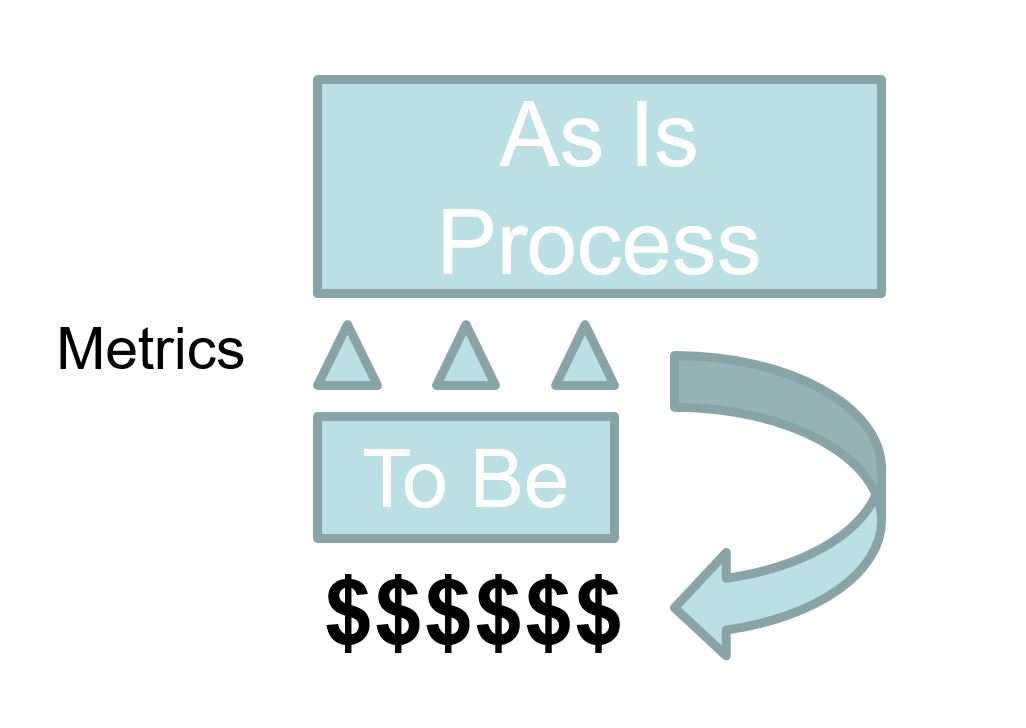
So I noticed recently that my personal morning routine had some waste in the process. If I could remove this waste I could sleep longer and still make it to work on time. That was enough motivation to get me started. I was going to re-engineer my morning process. I studied the current or "as is" process and found that the time waste was only just over a minute. But, when you think about the fact that this waste was part of a daily routine the minutes added up to 6 hours of waste in my life every year. I saw this as 6 more hours of sleep annually. I found that to be an amazing discovery so I set off to remove the issues from the process. As part of my current process I shaved prior to brushing my teeth. The problem with this was that I had to wait for the water to warm up before shaving. Cold water causes an off quality shave and is a safety issue with a blade. This delay also included a waste of natural resources namely off temperature water.  By remapping my morning process to include brushing my teeth while the water warmed up and before I shaved, I made use of the off quality (cold) water and did not have the associated idle time. While I brushed my teeth the water would warm for the shave. I tested and verified that the new process was effective and made it my target or "to be" process. Now I only had to ingrain the change into my lifestyle. Change management and visual reminders were important because at 6 AM I am not always at the top of my game. I found myself falling back into the old way without the reinforcing elements. Over time it became the way of doing my morning and the reinforcing systems were no longer as important and could be relaxed or removed. The changed state was now the new current state.
If you think about your processes at home or your business processes at work, you travel through this same re-engineering process. First you look at the "as is" process and identify what does not work. You find a motivator for the effort required. Then you re-engineer and remove the non-value added steps creating the "to be" process. Next you put in place reinforcing systems like metrics and that drives the change in behavior to get the value from the new process.

That is Business Process Re-engineering simplified!

Monday, August 3, 2015

10 Quotes That Could Mean Your Maintenance Program is Not Quite Best Practice

The following are ten quotes I have heard over the years that might not speak well of your maintenance and reliability efforts or the culture that has been created. The question is have you heard any of these in your facility? What did you do?

"I don't need a vibration analyzer, I use a screw driver and my ear."
"Prebreak is a thing. You can not go to break with dirty hands"
"The way we do it now is obviously the best way... Obviously, or we would not do it that way."
"A hammer is a precision maintenance tool and a knife is an acceptable screwdriver"
"Grease is grease and oil is oil"
"Is this an interruption? My break clock restarts with any interruptions"
"My maintenance jobs expand and contract to fit the job estimates. Tell me how long you want it to take"
"Our maintenance guys come in pairs and sometimes coveys regardless of the size and scope of the job"
"Our maintenance guys know the best gossip because we send them back and forth over and over for parts and tools and they see and talk with everyone."
"Yea we have predictive maintenance tools they are on the shelf in the office" under a coating of dust.

Please share you favorites below in the comments... Do not be shy we know the quote came from another plant not the one you work in now.

If you want to change the culture of your facility check out these post by clicking here!


Tuesday, July 28, 2015

Five questions you have to answer before your next change initiative.

We all are part of change initiatives and interestingly the majority of them fail to deliver the results expected or projected. When we look back at the ones that failed to deliver, we find many that were destined to fail from the beginning because of the way the change was unveiled and communicated to the affected individuals. Below are five question that are crucial to answer upfront, repeatedly, and through multiple medias. I will demonstrate the questions using a hypothetical Enterprise Asset Management System (EAM) or Computerized Maintenance Management System (CMMS) implementation as the example and share a few elements that satisfy a portion of the questions.  
1. Why are we doing this? 
 Example: Tell them about the transparency the new EAM provides.  You might also share the fact that it is connected with all of the other management systems from procurement and human resources and it allows the business to be better managed by tearing down the walls between these departments. In the end it will make the business more efficient and will help us to surpass our competitors. 
2. What does this look like?
Example: Show them the master project plan for the EAM roll out with the dates and areas of focus. Allow them to drill down into the plan so they can see the details where it is of interest. This will help with the next question. 
3. How will it affect me? or What's in it for me?
Example: Show them how the new system will change their current role. Hopefully you can show them areas where the new system is easier and better for them. This can be done with the work flow process maps or the RASI or RACI documents that were created during the blueprinting phase of the EAM implementation.  If RASI or RACI is a new acronym check out this post here.
4. What do you expect from me?
Example: This is where you can take them through specifically the "R's" or Responsibilities relating to their role. These are shown in the RASI documents. These responsibilities are what is required for the process to work effectively and it shows what you need for them to do specifically to meet the needs of the change.
5. What can I expect from you?
Example: This is where you might share the "R's" that you own and what you will also provide from an "A" or accountability standpoint.
These examples only begin to scratch the surface of the information that you need to provide but should give you some context for each question. Please take the time to plan out how you are going to communicate each of these points out to all the different groups that will be affected by the change.
 If you have other questions that we should consider please add them in the comments below. 

Wednesday, July 22, 2015

The What Is Series: What is Blended Learning?

Blended Learning is a phrase that we are starting to hear more and more about both in university and corporate training environments. Let us look at what it is. Wikipedia defines it here as combining both traditional face to face instructor led training and computer based e-learning in order to create opportunities for improved student data collection and customization of instruction and assessment. This allows the instructor to better cater to the individual students needs and desires.
We at Eruditio take it a step further and create an advanced form of blended learning using our Applied Learning Process where we combine multiple medias including:
  • Face to face instruction
  • Live action and computer animated video
  • Interactive 3D environments
  • Real world examples
  • Traditional e-learning
  • One on one virtual coaching
  • Augmented reality 
  • Gamification
  • Project based learning
This lead to a superior student experience, higher material retention and a documented return on investment for the training efforts.  You can see a few testimonials from both students and corporate leaders here. They will share with you how this type of education has changed learning and culture in their facilities. Please reach out to me if you want to discuss how we might create packaged and custom Blended Learning for your site or company.